
Presentation Schedule

Education, Culture, and the Environment in an AI-Driven Era
Saturday, 3 January 2026 16:30
Session: Conference Plenary Session
Room: Hawaii Convention Center: Room 310
Presentation Type: Featured Panel Session
Artificial Intelligence (AI) has been presented to us as a technological tool that helps advance knowledge, delivering innovations and solutions to our many challenges in a much more productive and efficient way than ever before. While AI continues to evolve rapidly and open new doors, this progress also comes with a price. AI helps analyse complex data, yet has immense environmental impacts. It can empower learners, yet it can be culturally biased. AI has already significantly changed how students engage in research, yet what they gather comes from models indexed mostly from specific cultural sources of knowledge rather than a diverse range.
This panel will look at the promise of AI and the pitfalls we should be aware of in areas such as education, culture, and the environment. Panellists will discuss what our growing daily reliance on AI means for the future and how we might harness its benefits while minimising costs and risks to society.
Biographies
Jun Arima

Professor Jun Arima is the President of IAFOR, and the senior academic officer of the organisation. In this role, Professor Arima is the Honorary Chair of the International Academic Advisory Board, as well as both the Academic Governing Board and its Executive Committee. He also sits on the IAFOR Board of Directors.
Jun Arima was formerly Director General of the Japan External Trade Organization (JETRO), UK from 2011 to 2015 and Special Advisor on Global Environmental Affairs for the Ministry of Economy, Trade and Industry (METI), Japan, from 2011 to 2015. He has previously held various international energy/environment-related positions, including: Head of Division, Country Studies, International Energy Agency (IEA); Director, International Affairs Division, Agency of Natural Resources and Energy, METI; and Deputy Director General for Environmental Affairs at METI’s Industrial Science and Technology Policy and Environment Bureau. In the COP (UN Convention on Climate Change) 14, 15 and 16, he was Japanese Chief Negotiator for AWG-KP.
Since 2015 Jun Arima has been a Professor at the University of Tokyo, Japan, where he teaches Energy Security, International Energy Governance, and Environmental Policies in the Graduate School of Public Policy. (GraSPP). He is also currently a Consulting Fellow at the Japanese Research Institute of Economy, Trade and Industry (RIETI). He is also Executive Senior Fellow at the 21st Century Public Policy Institute, Principal Researcher at the International Environmental and Economic Institute (IEEI), Distinguished Senior Policy Fellow, at the Asia Pacific Institute of Research (APIR), Senior Policy Fellow on Energy and Environment, Economic Research Institute for ASEAN and East Asia (ERIA), and was the Lead Author, the 6th Assessment Report of the Intergovernmental Panel of Climate Change (IPCC).
Peter J Mataira
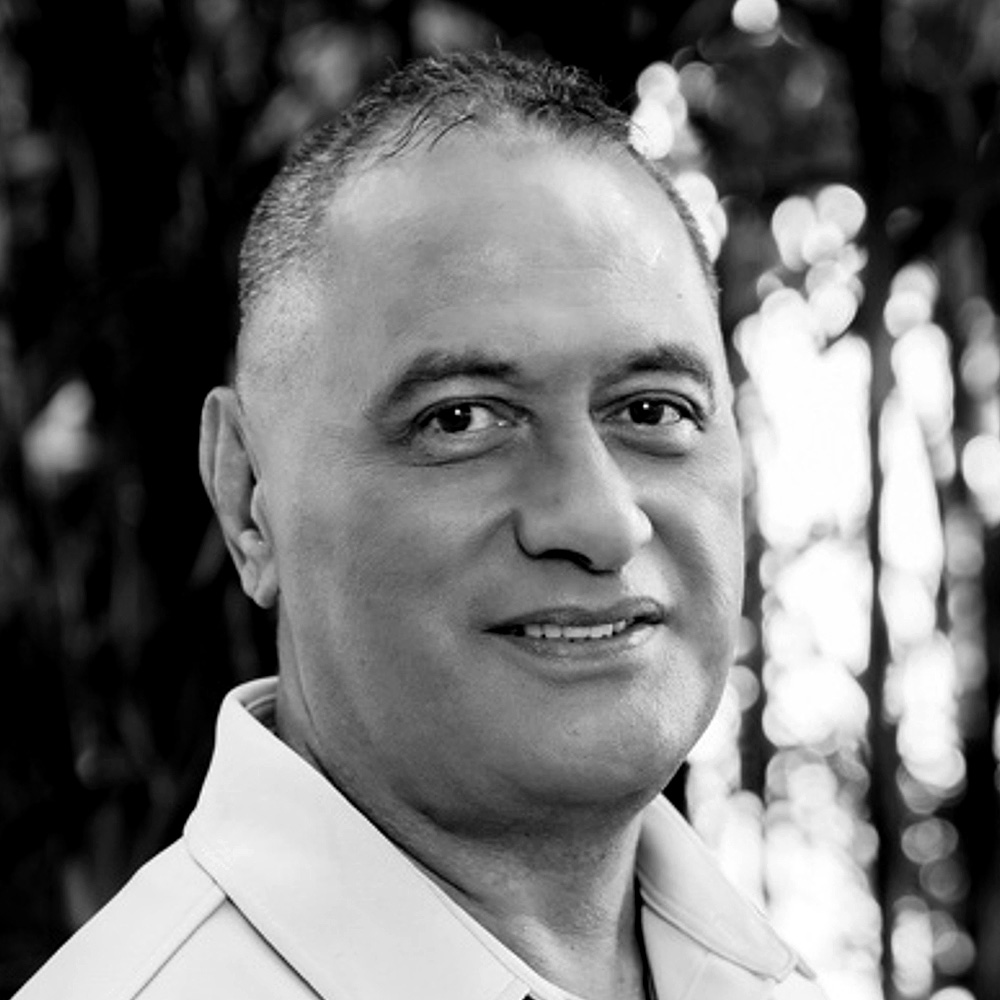
Dr Peter Mataira (Māori, Aotearoa New Zealand) is a Professor of Social Work at Hawaiʻi Pacific University (HPU) where he teaches courses in research, community and organizational practice, clinical assessments, and ethics. A passionate advocate for Indigenous health equity and social justice, Dr. Mataira recently co-led two National Institutes of Health (NIH) projects exploring how artificial intelligence and machine learning (AI/ML) can help reduce health disparities among vulnerable populations in Hawai'i and the Pacific through predictive modeling. His work bridges Indigenous knowledge systems, data sovereignty, and community-based participatory research (CBPR) with cutting-edge technologies that support culturally grounded solutions. Dr. Mataira and his colleague from HPU’s College of Computer Sciences recently submitted a R21 NIH grant to test their assistive clinical model. He currently supervises two practicum students on projects that examine how AI tools support community-defined goals for food security and on youth suicide education and prevention.
LJ Rayphand

LJ Rayphand is an educational leader and researcher from Chuuk State, Federated States of Micronesia. He earned a PhD from the University of Hawaiʻi at Mānoa, United States, and has significantly contributed to education by preserving and promoting Chuukese culture through storytelling and technology.
Dr Rayphand is currently the Dean of Outreach Education at Caroline College and Pastoral Institute (CCPI) in Chuuk, an official partner of Chaminade University of Honolulu. Dr Rayphand also teaches at the Chaminade University of Honolulu, the University of Hawaiʻi at Mānoa, and the College of Micronesia-FSM, Chuuk Campus. His work focuses on integrating indigenous knowledge with modern educational practices to enhance learning outcomes for Pacific Islander students.
Dr Rayphand also serves in various capacities in Micronesia and Hawaii. He is currently a Professor in Residence with Chaminade University of Honolulu and a Faculty in Residence with the NSF INCLUDES Alliance. He is also a member of the REL Pacific Governing Board, Chuuk State Board of Education, Chuuk Vicariate Parish Council, and the Diocese of the Caroline Islands Board of Catholic Education.
Michael Menchaca

Michael Menchaca is a Professor in the Department of Learning Design and Technology at the University of Hawai'i at Mānoa, United States. He specialises in distance education, and has designed, implemented, and coordinated online and hybrid programs for over 20 years. He serves as editor for the IAFOR Journal of Education: Technology in Education Edition. He was an IT specialist for many years in the public and private sector. As an educator, he teaches and conducts research in the areas of online learning, technology integration, and social justice with technology.
About the Presenter(s)
-Professor Jun Arima is the President of IAFOR, and the senior academic officer of the organisation.
-Dr Peter Mataira (Māori, Aotearoa New Zealand) is a Professor of Social Work at Hawaiʻi Pacific University (HPU) where he teaches courses in research, community and organizational practice, clinical assessments, and ethics.
-LJ Rayphand is an educational leader and researcher from Chuuk State, Federated States of Micronesia.
-Michael Menchaca is a Professor in the Department of Learning Design and Technology at the University of Hawai'i at Mānoa, United States.
See this presentation on the full schedule – Saturday Schedule
Conference Comments & Feedback
Place a comment using your LinkedIn profileShare this Presentation


Comments
Powered by WP LinkPress