

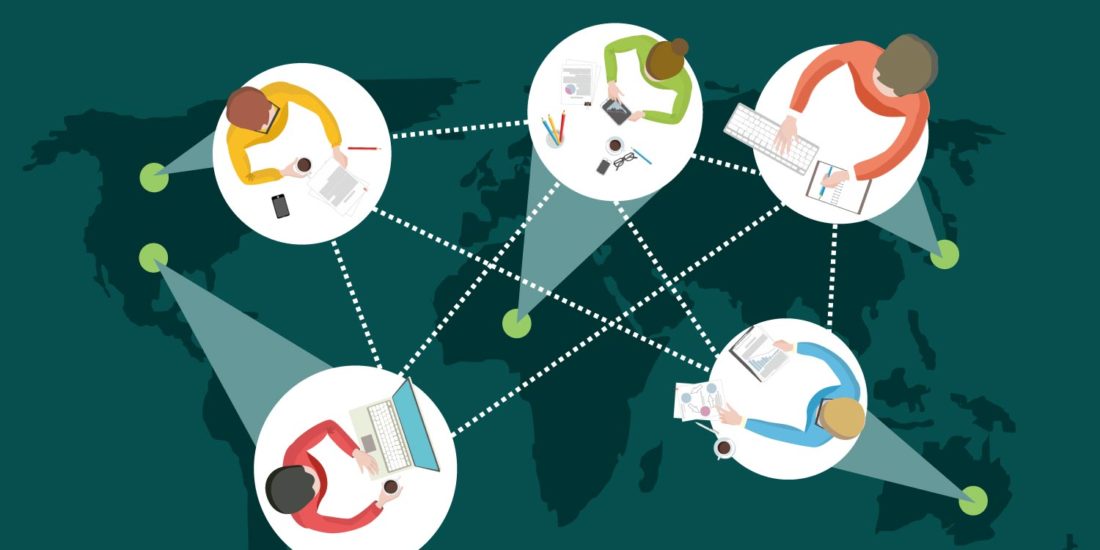
This presentation will explore the creation of collaborative virtual learning spaces suited to the needs of globally distributed, mid-career professional practitioners, where individuals enhance their practice through interaction with their peers. This draws on the concepts of Wenger’s ‘communities of practice’ (CoP) (2002) and Schön’s ‘reflective practitioner’ (1983). I seek to produce critically aware practitioners, able to work to the highest professional standards, who understand the power of collaboration and co-creation in the digital age. The presentation explores the experience of developing an online M.A. in Photojournalism and Documentary Photography. The course is practice-based and professional, and focused on a problem-based experiential approach to learning. Combining this with technology-enhanced social learning creates an environment where students, staff and visiting tutors share their reflections on their work in real time with their peers, leveraging and expanding their experiences as the basis of their learning, using a range of web 2.0 platforms. This design has been informed by Wenger’s ideas on creating ‘Digital Habitats’ (2009), where technology serves to enhance the ecology of learning by extending the potential for interaction and collaboration in a virtual world. The affordances of technology such as reflective blogs to enhance collaboration and peer review are leveraged to enhance the critical faculties and judgment of the participants. Schön’s concept of a ‘Practicum’ (1983) is central as an intermediate space between the worlds of work and study, fostering a community of practice that mirrors the larger professional community of photojournalism practice. Mapping and modeling this larger community prepares students for entry into the profession. Live web conferencing allows us to interact with the cohort and visiting faculty in real time, using images, presentations, web pages, live text, audio and video in one browser window. All lectures, seminars and tutorials are delivered in this way; combining the energy and involvement of face-to-face teaching with the flexibility of location afforded by a virtual environment. This is real ‘situated learning’ – the practitioner is able to physically live ‘in the story’, working on their projects in the field but getting real-time support from their peers and mentors.
